
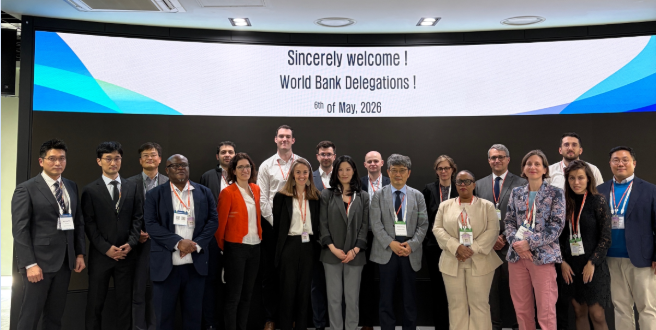
With support from the Korea Green Growth Trust Fund (KGGTF), the World Bank Group is connecting countries with Korean expertise to strengthen nuclear energy planning, financing, and implementation.
As countries seek reliable, affordable, and low-carbon energy to meet growing demand, nuclear power is attracting renewed attention. But moving from ambition to implementation requires more than technology. Governments must navigate complex financing arrangements, develop regulatory frameworks, build skilled workforces, and establish the institutions needed to manage nuclear energy programs safely and sustainably.
To help countries address these challenges, the World Bank Group (WBG), with support from KGGTF, organized a series of knowledge exchanges in April and May 2026, drawing on Korea's experience developing and managing its nuclear energy sector.
Learning from Korea's Nuclear Energy Experience
From May 5–8, 2026, seven senior government officials and technical experts from Bulgaria, Poland, South Africa, and Türkiye joined World Bank specialists for a technical study tour in Korea. Each country faces distinct challenges: Poland is preparing its first nuclear power program, Bulgaria is advancing a major new reactor project, Türkiye is constructing its first nuclear power plant, and South Africa is planning to expand its existing nuclear capacity.
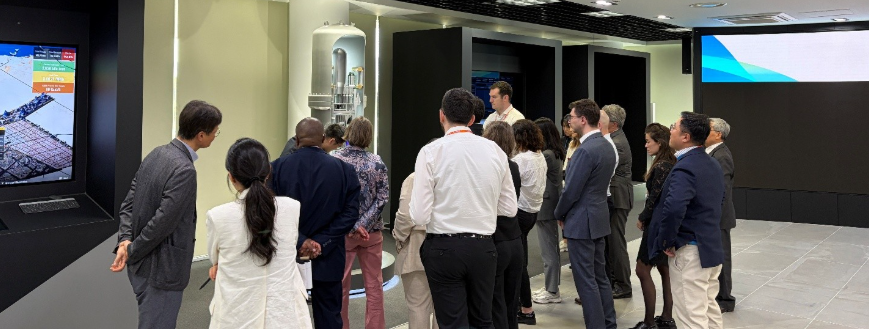
Participants engaged with leading Korean institutions, including Korea Hydro & Nuclear Power (KHNP), KEPCO International Nuclear Graduate School (KINGS), and Doosan Enerbility.
At KHNP's Central Research Institute, participants examined how small modular reactors (SMRs) could provide reliable energy for industrial facilities and support decarbonization. A visit to Doosan Enerbility offered practical insights into the manufacturing capacity and supply chains required for nuclear development, including opportunities for participating countries to involve domestic industries. At the Saewul Nuclear Power Plant, delegates observed Korea's approach to operational safety, workforce management, and long-term plant operations.
The delegation also participated in Korea Green Innovation Days (KGID) 2026 in Sejong, where country representatives discussed the practical challenges of advancing national nuclear energy programs.
Turning Knowledge into Action
The exchanges highlighted three areas where Korea's experience could directly inform participating countries' nuclear energy plans.
Making nuclear projects financially viable. Across all four countries, securing financing emerged as the most pressing challenge. Participants examined financing approaches, including Contracts for Difference, that could help attract private investment and reduce project risks. Discussions also highlighted the need for stronger technical and financial assessments, particularly for emerging SMR technologies where costs and business models are still evolving.
Building domestic industries and skilled workforces. At Doosan Enerbility, delegates explored how nuclear investments could support local manufacturing, supply chains, and skilled employment. A key lesson was the importance of incorporating local industry participation into project contracts from the outset, rather than treating it as a later consideration. Korea's experience training nuclear engineers and technicians also provided practical models for developing the expertise needed to support national programs.
Strengthening long-term planning and institutional capacity. Korea's experience demonstrated the importance of sustained government commitment, strong regulatory institutions, and coordinated planning across decades. For countries preparing new nuclear facilities, these lessons can help inform decisions on project preparation, safety oversight, workforce development, and long-term operations.
The study tour complemented two KGGTF-supported technical sessions at the World Bank's Energy Forum in Washington, DC, held April 27–May 1, 2026. More than 50 participants attended the nuclear-focused sessions, where Korean experts shared insights into nuclear fuel management, waste considerations, and the engineering and construction of large-scale nuclear infrastructure.
From Knowledge Exchange to Investment
At a pivotal moment for nuclear energy development in World Bank client countries, the exchanges identified concrete priorities for follow-up support: strengthening project financing, developing domestic technical expertise, and improving institutional readiness for nuclear investments.
Access to financing provided under established international export-credit frameworks can help host countries benchmark financing terms, strengthen due diligence, and make more informed decisions regarding affordability, risk allocation, and long-term fiscal exposure.
Building on these findings, the World Bank Group will explore how its advisory services and blended finance instruments could help countries overcome financing barriers and advance projects toward investment readiness.
Continued collaboration with KEPCO KINGS and KHNP will support the development of country-specific technical assistance, including expertise in nuclear project preparation, workforce training, and institutional capacity building. The World Bank's partnership with the International Atomic Energy Agency (IAEA) will further strengthen access to international technical expertise and knowledge on nuclear energy planning.
By connecting policymakers and technical specialists with Korea's experience, KGGTF is helping countries move beyond broad nuclear energy ambitions toward practical decisions on financing, project development, and implementation—laying the groundwork for more reliable, secure, and low-carbon energy systems.
Grant: Scoping Investment Pipeline and Promoting Knowledge Sharing for Long-Term Operation of Nuclear Power Plants
Grant Year: Year 13 (2026)
TTLs: Lauren Culver, Senior Energy Specialist; Selena Jihyun Lee, Energy Specialist
K-Partners: Korea Hydro & Nuclear Power (KHNP), KEPCO International Nuclear Graduate School (KINGS), and Doosan Enerbility