
Bogotá has long been recognized as a global leader in urban mobility innovation. From pioneering the TransMilenio Bus Rapid Transit (BRT) system to expanding sustainable transport infrastructure, the city has demonstrated how bold policy decisions can transform how people move. But as Bogotá continues to grow, a new challenge has come into focus: how to better manage limited road space in a way that reduces congestion, improves access to jobs and services, and mitigates the transition from sustainable transport modes to private vehicle use, while supporting a cleaner urban environment. The answer may lie not in building more roads—but in using them more intelligently.
Building the analytical foundation
With support from the Korea Green Growth Trust Fund (KGGTF), the World Bank worked with Bogotá’s Secretariat of Mobility to explore how Travel Demand Management (TDM) tools—such as congestion charging and externality-based road pricing—could improve traffic efficiency, safety, and environmental outcomes. This analytical work, carried out under the grant “Smart Travel Demand Management Policies for Developing Green and Sustainable Transportation: Deep Dive in LAC Cities, builds on Bogotá’s existing efforts by providing a structured framework to advance toward more economically efficient demand management mechanisms. It helps strengthen pricing, data, and enforcement systems to change travel behavior, including more robust “pay-to-circulate” schemes for restricted vehicles based on plate number.
Rather than focusing only on infrastructure expansion, the analysis highlighted how policy, technology, and incentives can play a complementary role in managing congestion. But analysis alone is not enough.
Moving from concepts to implementation
Building on this foundation, Bogotá was selected as a winner of the Seoul Official Development Assistance (ODA) Challenge, launching a new phase of collaboration with the Seoul Metropolitan Government (SMG) and the Seoul Urban Solutions Agency (SUSA). This next phase focuses on a critical transition: turning policy ideas into operational systems.
The collaboration is helping Bogotá design a practical, phased roadmap for implementing congestion management tools, including:
- Smart enforcement systems using automated cameras and integrated control platforms
- User-friendly payment, registration, and permit systems
- Data frameworks to monitor traffic conditions and refine pricing policies over time
- Integration with existing Intelligent Transport Systems (ITS)
- Communication strategies to build public understanding and acceptance
- Expanded use of enforcement technologies to address illegal parking, bus lane protection, and road safety
Together, these elements move the conversation from whether congestion pricing is possible—to how it can be implemented effectively.
Learning from practice: a technical mission in Bogotá
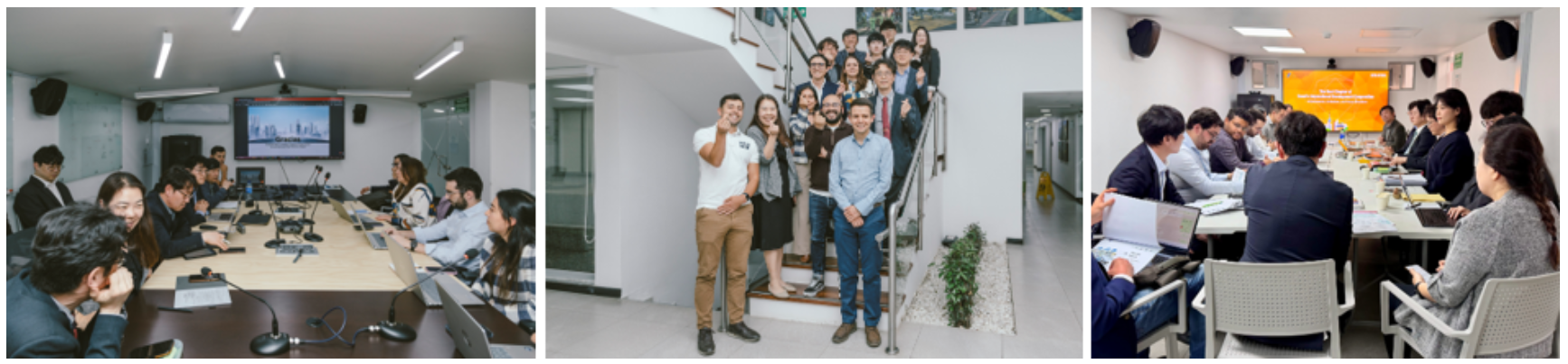
In January 2026, a Korean technical delegation visited Bogotá to support the project’s inception phase under the initiative “Designing Bogotá’s Intelligent Congestion Charge Scheme.” The delegation—bringing expertise from SMG, SUSA, Hanyang University, and Moon Engineering—worked closely with Bogotá’s institutions responsible for transport, digital systems, and public safety. The mission combined technical discussions with hands-on observation:
- Meetings with the Secretariat of Mobility, Security Secretariat, and planning agencies
- Coordination with the World Bank and Instituto de Desarrollo Urbano (IDU)
- Technical sessions with ICT teams managing traffic data systems
- Site visits to the Traffic Management Center (CGT) and Infraction Processing Center (CPIT)
- Field surveys of major corridors and the Pico y Placa restriction system
- Engagement with telecommunications and energy providers on infrastructure requirements
These exchanges provided a detailed understanding of Bogotá’s current systems—and the institutional, technical, and data requirements needed to implement congestion charging in practice.
What Bogotá and Seoul can learn from each other
At the heart of the partnership is a simple but powerful idea: cities can accelerate progress by learning from each other’s experience. While Bogotá and Seoul differ in income levels and infrastructure, their comparison reveals important insights. Seoul, with higher income levels and a much larger number of daily trips, experiences shorter commute times and lower congestion levels. This reflects a combination of:
- Extensive high-capacity public transport networks
- Advanced traffic management systems
- Complementary demand management tools such as congestion pricing and parking regulation
For Bogotá, this reinforces a key lesson: infrastructure investments alone are not enough—managing demand is equally critical.
Seoul’s experience offers practical examples:
- Targeted congestion pricing, such as in the Namsan tunnels, reducing traffic while maintaining public acceptance
- Integrated traffic management platforms (TOPIS) that combine real-time data, public transport information, and emergency response
- Automated enforcement systems that improve compliance and reduce illegal parking
These examples show how technology, policy, and governance can work together to improve mobility outcomes.
Building capacity for long-term impact
The next phase of the collaboration will focus on refining system design and strengthening institutional capacity. A central component will be a study visit to Korea, where Bogotá officials will engage directly with Seoul’s transport systems, operational platforms, and policy frameworks. These exchanges will help build the skills needed not just to launch a congestion management system—but to operate and adapt it over time.
A model for scaling smarter mobility solutions
Bogotá’s journey—from analytical groundwork to implementation design—illustrates how cities can move toward more efficient, sustainable mobility systems. It also highlights the role of partnerships. By connecting World Bank operational teams, Korean institutions, and city-level counterparts, KGGTF is helping translate global knowledge into locally tailored solutions. As more cities face rising congestion, fiscal constraints, and climate pressures, Bogotá’s experience offers a replicable model: start with evidence, build institutional capacity, and move steadily from analysis to action.