
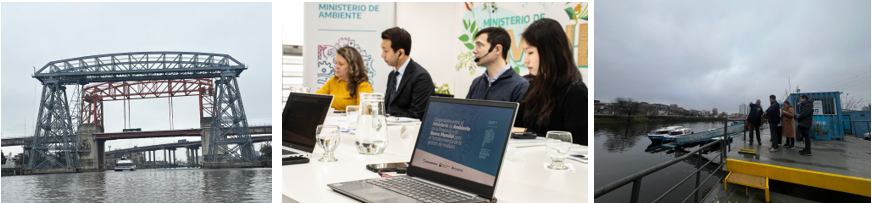
Earlier this June, the Matanza Riachuelo Sustainable Development Project in Argentina welcomed a high-level delegation from the Export-Import Bank of Korea (KEXIM). Their visit to the Province of Buenos Aires offered more than a site visit: it spotlighted how international collaboration can transform waste into opportunity and drive the circular economy in one of Latin America’s most complex urban regions.
The Korean delegation, hosted by the World Bank alongside provincial leaders including Environment Minister Daniela Vilar, witnessed firsthand the Province’s evolving approach to solid waste management. A guided tour of the Matanza-Riachuelo river with the Basin Authority ACUMAR underscored both the urgency and the potential of cleaner waterways. But what truly impressed the visitors was Buenos Aires’ new solid waste strategy—supported by the World Bank—which lays out a bold roadmap for investment and reform. Already being translated into a legal framework, it signals a decisive step toward institutionalizing sustainable waste practices.
This new vision did not emerge in isolation. It draws inspiration from an earlier Argentine mission to Korea supported by the World Bank’s Korea Green Growth Trust Fund, where provincial leaders studied reuse industries, circular startups, and policy innovations. At the Korea Environmental Industry & Technology Institute (KEITI), they saw how Korea nurtures green entrepreneurship by turning discarded materials into market-ready products. That experience planted the seeds for a similar initiative in Buenos Aires: the Province is now exploring a local innovation hub to foster startups, accelerate reuse, and anchor circular economy principles in practice.
The impact of such exchanges goes beyond the technical. They show how a problem that afflicts cities worldwide—waste piling up faster than it can be managed—can become a springboard for innovation, jobs, and cleaner growth when paired with international partnerships. Korea’s advanced models offer Argentina a mirror of what is possible; Argentina’s adaptation, in turn, offers lessons for other middle-income countries searching for practical pathways to sustainability.
KEXIM’s delegates left Buenos Aires with admiration for the professionalism and ambition of their hosts, but also with a renewed appreciation for the power of global cooperation. In the fight for sustainable development, no country has all the answers. But by sharing ideas, adapting models, and building trust across borders, countries can accelerate the transition to systems where waste is not an end point but a beginning.
Buenos Aires’ story is still being written. Yet its partnership with Korea already proves one essential truth: the circular economy is not just an environmental agenda—it is an engine for opportunity, and a reminder that progress travels fastest when it is shared.
Grant: Circular Economy for Waste Management in Province of Buenos Aires
Grant Year: Year 10 (2022)
TTLs: Maria Catalina Ramirez, Senior Water Supply and Sanitation Specialist