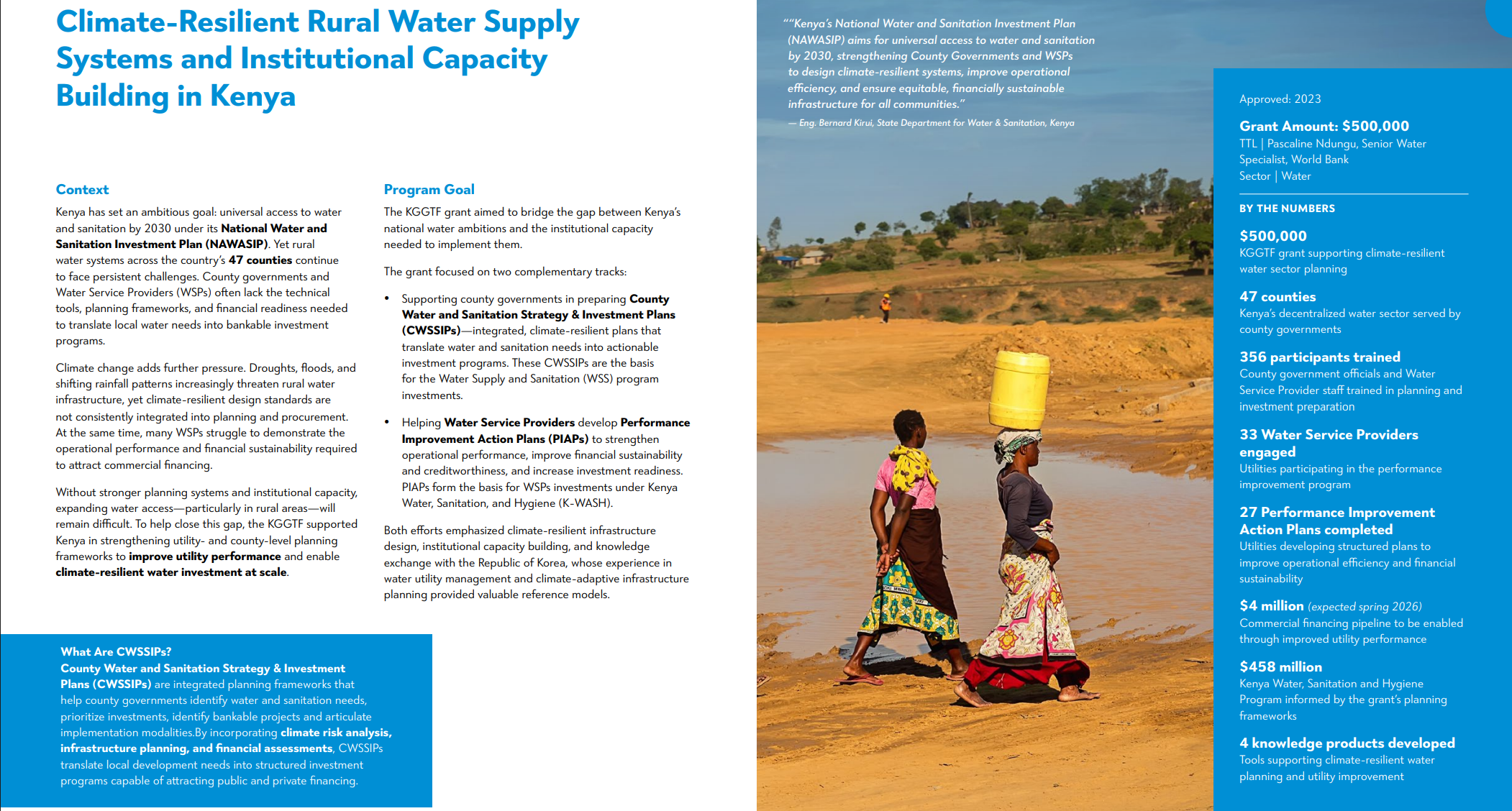
Kenya has set an ambitious goal: universal access to water and sanitation by 2030 under its National Water and Sanitation Investment Plan (NAWASIP). Yet rural water systems across the country’s 47 counties continue to face persistent challenges. County governments and Water Service Providers (WSPs) often lack the technical tools, planning frameworks, and financial readiness needed to translate local water needs into bankable investment programs.
Climate change adds further pressure. Droughts, floods, and shifting rainfall patterns increasingly threaten rural water infrastructure, yet climate-resilient design standards are not consistently integrated into planning and procurement. At the same time, many WSPs struggle to demonstrate the operational performance and financial sustainability required to attract commercial financing.
Without stronger planning systems and institutional capacity, expanding water access—particularly in rural areas—will remain difficult. To help close this gap, the KGGTF supported Kenya in strengthening utility- and county-level planning frameworks to improve utility performance and enable climate-resilient water investment at scale.
The KGGTF grant aimed to bridge the gap between Kenya’s national water ambitions and the institutional capacity needed to implement them. The grant focused on two complementary tracks:
- Supporting county governments in preparing County Water and Sanitation Strategy & Investment Plans (CWSSIPs)—integrated, climate-resilient plans that translate water and sanitation needs into actionable investment programs. These CWSSIPs are the basis for the Water Supply and Sanitation (WSS) program investments.
- Helping Water Service Providers develop Performance Improvement Action Plans (PIAPs) to strengthen operational performance, improve financial sustainability and creditworthiness, and increase investment readiness. PIAPs form the basis for WSPs investments under Kenya Water, Sanitation, and Hygiene (K-WASH). Both efforts emphasized climate-resilient infrastructure design, institutional capacity building, and knowledge exchange with the Republic of Korea, whose experience in water utility management and climate-adaptive infrastructure planning provided valuable reference models.
Grant: Strengthening the Capacity of Kenya County Governments and Water Services Providers to Design and Implement Green and Climate Resilient Water Supply Systems
Grant Year: Year 11 (2023)
TTL: Pascaline Ndungu, Senior Water Specialist, World Bank
This grant spotlight is excerpted from the 2025 KGGTF Annual Report (Download here)