
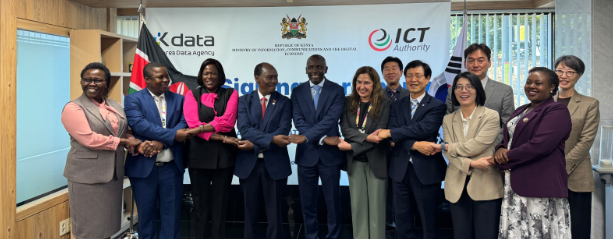
Building on a KGGTF-supported knowledge exchange held in Korea from May 4-15, 2026, Memorandum of Understanding (MoU) between ICTA and K-DATA was signed on October 21, bringing the two institutions together to explore tangible AI applications for public services, more reliable government data, and the skills and standards needed to put them to work.
A knowledge exchange in Korea can open doors. The next step is deciding what to build together. Kenya’s Information and Communications Technology Authority (ICTA) and the Korea Data Agency (K-DATA) have signed a memorandum of understanding (MoU) focused on data, artificial intelligence (AI), digital transformation, and data-driven innovation. This agreement, facilitated by the World Bank through engagement supported by the Korea Green Growth Trust Fund (KGGTF), opens up new avenues for technical collaboration, capacity building, and joint initiatives.
The agreement marks an important step toward translating international knowledge sharing into sustained institutional relationships and concrete opportunities for implementation.
Putting AI and Data to Work in Government
A central priority of the five-year MoU is developing an AI-ready data ecosystem to help Kenya use emerging technologies to improve public service delivery. The two institutions intend to identify two to three high-impact AI applications in digital government, assess the availability, accessibility, quality, and interoperability of the datasets needed to support them, and explore pilot projects linking selected government datasets. The collaboration will also assess institutional and technical readiness, helping identify the systems, standards, and capabilities needed to put AI solutions into practice.
Beyond these initial priorities, the partnership will explore three complementary areas of cooperation:
-
Data and AI readiness: Strengthening data infrastructure, developing high-quality datasets, exploring synthetic data applications, and training data professionals to support AI adoption.
-
Trusted data governance and exchange: Improving data quality, interoperability, cybersecurity, and secure government data sharing, including cooperation on digital clearing houses, data exchange frameworks, and responsible public and private data use.
-
Digital innovation and institutional capacity: Sharing expertise on smart cities, digital twins, intelligent transport systems, and emerging technologies, alongside technical assistance, regulatory cooperation, and technology transfer.
Together, these activities could help Kenya develop more reliable and connected government data systems, strengthen the institutional foundations for responsible AI adoption, and support the development of more efficient and responsive digital public services.
Turning Cooperation into Measurable Results
The ICTA–K-DATA agreement goes beyond identifying areas of cooperation by establishing a Joint Committee responsible for translating shared priorities into implementation plans and measurable activities.
The committee will develop an overarching implementation plan and annual work programs identifying priority projects, institutional responsibilities, timelines, expected outputs, and resource requirements. Progress may be tracked through concrete indicators, such as the number of government services reviewed or redesigned, systems assessed against interoperability standards, technical staff trained, data standards or guidelines developed, and joint pilots launched.
The committee will meet at least annually to monitor implementation, assess outcomes, and identify future activities. Cooperation may be delivered through training and fellowships, technical assistance, expert exchanges, joint research, and pilot initiatives.
The agreement will remain in effect for five years, with the possibility of extension by mutual consent. Specific joint programs may also seek financing from development partners and other agreed funding sources, subject to availability.
From Knowledge Exchange to Implementation
The agreement builds on a May 2026 knowledge exchange visit to Korea supported by the KGGTF, during which Kenyan officials engaged with various Korean institutions to explore practical solutions to national development priorities. The visit included participation in Korea Green Innovation Days (KGID) 2026, which brought together World Bank teams, client governments, and Korean partners to share expertise and identify opportunities for collaboration.
For KGGTF, the agreements illustrate how targeted investments in knowledge exchange can lay the groundwork for longer-term development partnerships. What began as an opportunity for Kenyan officials to learn from Korean experience has helped establish institutional relationships and formal frameworks for continued technical cooperation.
As the partners develop implementation plans and identify pilot activities, these agreements provide a pathway for translating shared knowledge into practical improvements in government systems and services—demonstrating how knowledge exchange can serve as a catalyst for institutional change and longer-term development impact.
Grant: Enhancing Data Sharing and Use for Scalable AI Solutions in Kenya
Grant Year: Year 13 (2026)
TTLs: Aneliya Muller, Senior Digital Specialist