
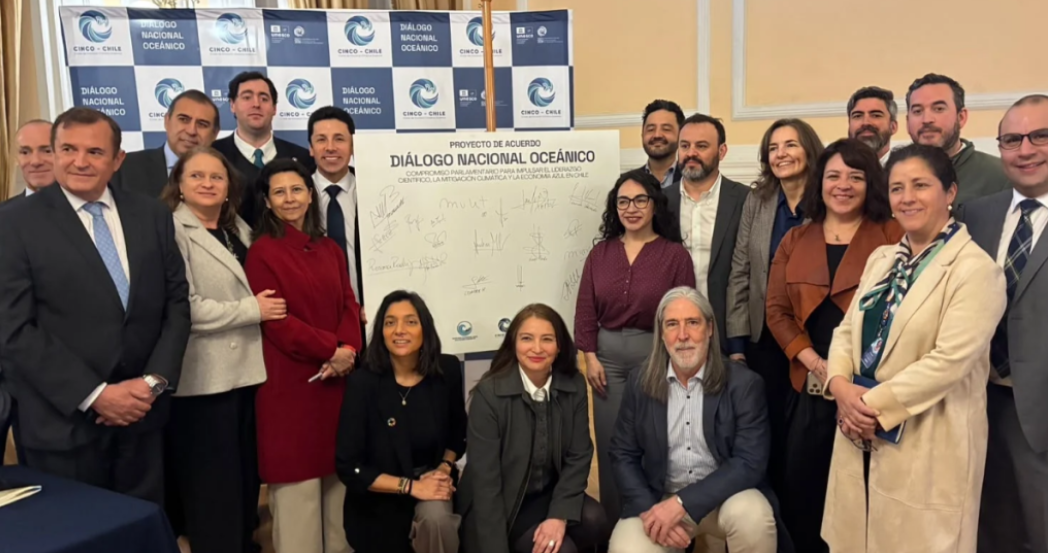
The initiative marks a new step in the work developed by the Blue Economy and Ocean Solutions Caucus, the Senate Ocean Caucus and CINCO Chile, aimed at contributing to a roadmap for the country and strengthening coordination between Congress, the Executive, the scientific community, the private sector and international organizations.
The Minister of Science, Technology, Knowledge and Innovation, Ximena Lincolao, highlighted the leadership assumed by Congress and the opportunities opening up for Chile due to its oceanic status: “It is truly an honor and a privilege to see senators and representatives at the table today taking the lead on something as important as the issue of the oceans, which today is much more than we could have imagined in the past. It is the power and the opportunity that Chile has to lead and participate in global economies and to do so in a responsible way, considering the environment and the habitability of the ocean,” she stated.
The president of the Ocean Caucus, Senator Sergio Gahona (UDI), highlighted the cross-party consensus achieved around this agenda and the need to transform that interest into concrete actions: “There is a genuine interest from all of us, both in the Chamber of Deputies and in the Senate, to be able to advance on ocean issues and have a constructive dialogue between all actors, whether in political terms, but also academic, scientific and from the Executive Branch,” he stated.
Gahona, president of the Environment, Climate Change and National Assets Commission, also proposed incorporating into the draft resolution Chile's commitment to the Treaty on Marine Biodiversity in Areas Beyond National Jurisdiction (BBNJ) and Valparaíso's candidacy to host its General Secretariat.
For his part, the president of the Blue Economy and Ocean Solutions Caucus, Representative Mauro González (RN), emphasized the importance of coordination between the State, the private sector, science, academia, and civil society to advance a national public policy: “By seeking and coordinating these pillars, we can move towards a national public policy for our ocean. We can also strengthen science, innovation, and technology, and that is where, as parliamentarians, we must have the capacity to act across the board,” he stated.
González also highlighted that this agenda has brought together territorial representation from the north to the south of the country and diverse political perspectives. “This isn’t about one political sector; it’s about Chile,” she emphasized.
Similarly, Deputy Andrea Macías (PS), a member of the Committee on Fisheries, Aquaculture and Maritime Interests and Extreme Zones and Chilean Antarctica, valued the fact that the work initiated from the scientific field is progressively incorporating new actors and acquiring a national dimension: “Today, in this second and more massive activity, apart from the one that was done at the scientific level in the south, I think that all the work and the challenge that we have in these matters is gaining much more strength,” she stated.
The event also included the participation of Commander Fernando Gallegos, from the Directorate of Maritime Interests and Aquatic Environment (DIRINMAR), who participated as a speaker representing the Chilean Navy, contributing the institutional and maritime perspective to a conversation that seeks to coordinate different capabilities and actors linked to the ocean.
Financing, cooperation and opportunities for Chile
From an international perspective, Felipe Lizana, an agricultural economist and blue economy consultant at the World Bank, highlighted the conditions that the country presents to take advantage of the growth of the blue economy: “Chile is precisely well positioned to capture the opportunities of the blue economy,” said Lizana, who explained that this view “is not just about producing more in the ocean, it is about producing better and producing more sustainably.”
During his presentation, the World Bank Group representative also addressed the growth of the international portfolio of projects related to these areas and the opportunities they present for Chile. He also referred to the work carried out in Chile, Peru, and Ecuador regarding seaweed and new value chains, financed by the Korea Green Development Fund (KGGTF), a partnership between the World Bank Group and Korea that supports countries in developing innovative and sustainable growth strategies and investments.
Connecting science, innovation and development
Leonardo Valenzuela, senior director of International Partnerships and Public Policy at Ocean Visions, focused on one of the challenges for the development of ocean solutions: ensuring that scientific knowledge can be effectively transformed into innovation and reach the industry.
“All this knowledge being generated at the university level is not reaching the world as a solution, it is not being transferred to the industrial sector, it is not having the relevance that the production of certain laboratories should have,” he noted.
In this context, Marine Carbon Removal (mCDR) is part of the emerging research areas associated with ocean-based climate solutions. The challenge posed during this process is to generate evidence and develop the country's own scientific capabilities to responsibly evaluate these alternatives and make knowledge-based decisions.
From a national perspective, oceanographer Iván Pérez, from the i~mar Center of the University of Los Lagos, raised the need to strengthen scientific and ocean observation capabilities in Chile as a condition for generating its own knowledge and supporting with evidence the decisions that the country adopts in this matter.
From dialogue to concrete commitments
For María José Urrutia, executive director of CINCO Chile, the meeting allowed progress from conversation and diagnosis to commitments that will give continuity to the process: “This meeting allowed us to move from dialogue to concrete commitments. The fact that parliamentarians from different political parties are promoting a draft resolution is a very important sign for moving towards a Chilean ocean roadmap. The challenge now is to continue bringing together Congress, the scientific community, the public sector, local communities, and international organizations to transform existing capabilities into opportunities for sustainable development for the country,” Urrutia stated.
The draft resolution will be the first step in a new phase of work. The proposal seeks to advance an intersectoral body for a roadmap of ocean environmental solutions, address the regulatory conditions necessary for research development, and strengthen applied ocean science and its infrastructure in the territories. The minutes prepared after the meeting include, among other areas, an intersectoral working group, a pro-science regulatory framework, and a plan to promote applied ocean science and territorial investment.
In this way, the process initiated from science and the territories now adds a cross-cutting political commitment, with the challenge of progressively advancing towards budget, projects, research, international cooperation and leadership, articulating the capacities that Chile already possesses to sustainably take advantage of the opportunities offered by its ocean.