
By: Onsol Cho, KGGTF 2026 Youth Intern
On March 10, as part of the KGGTF Youth Internship Program, Hwang Dong-soo, CEO of BlueCaBorn and Professor at POSTECH's Graduate School of Marine Science and Environmental Engineering, delivered a lecture on ocean-based carbon capture and the technology his startup is developing to address it. To set the scene, Prof. Hwang briefly traced how cheap maritime logistics made coastal industry the engine of economic growth across America, Japan, Korea, and China — and how that same model, while transformative for development, became one of the world's heaviest sources of carbon emissions.
This intersection of coastal industry and carbon output is where Prof. Hwang's research takes a new direction. Motivated in part by reading Bill Gates' book on climate change, he was struck less by the science of warming than by its inequity: the carbon emitted by wealthy, industrialised nations disproportionately destroys the livelihoods of the world's poorest people, who lack the resources to adapt. This conviction, combined with his background researching marine organisms such as mussels and oysters, led him to found BlueCaBorn and pursue ocean-based carbon capture.
Direct air capture, the removal of CO₂ directly from the air, is technically possible but extremely difficult. In direct air capture, carbon dioxide exists in the atmosphere at roughly 400 parts per million (ppm), meaning about 4 CO₂ molecules in every 10,000 air molecules. Capturing it requires massive infrastructure, enormous energy input, and vast land areas. A Swiss company operating in Iceland (chosen for its cheap geothermal energy and low land costs) has targeted 10,000 tonnes per year but achieved only around 1,000 tonnes. For Korea, with its high land costs and reliance on fossil-fuel electricity, the economics are even more punishing. Ocean water, however, is roughly 200 times more concentrated in dissolved CO₂ than the air above it. Switching from air to seawater transforms the capture problem from finding a needle in a very large haystack to finding one in a much smaller pile.
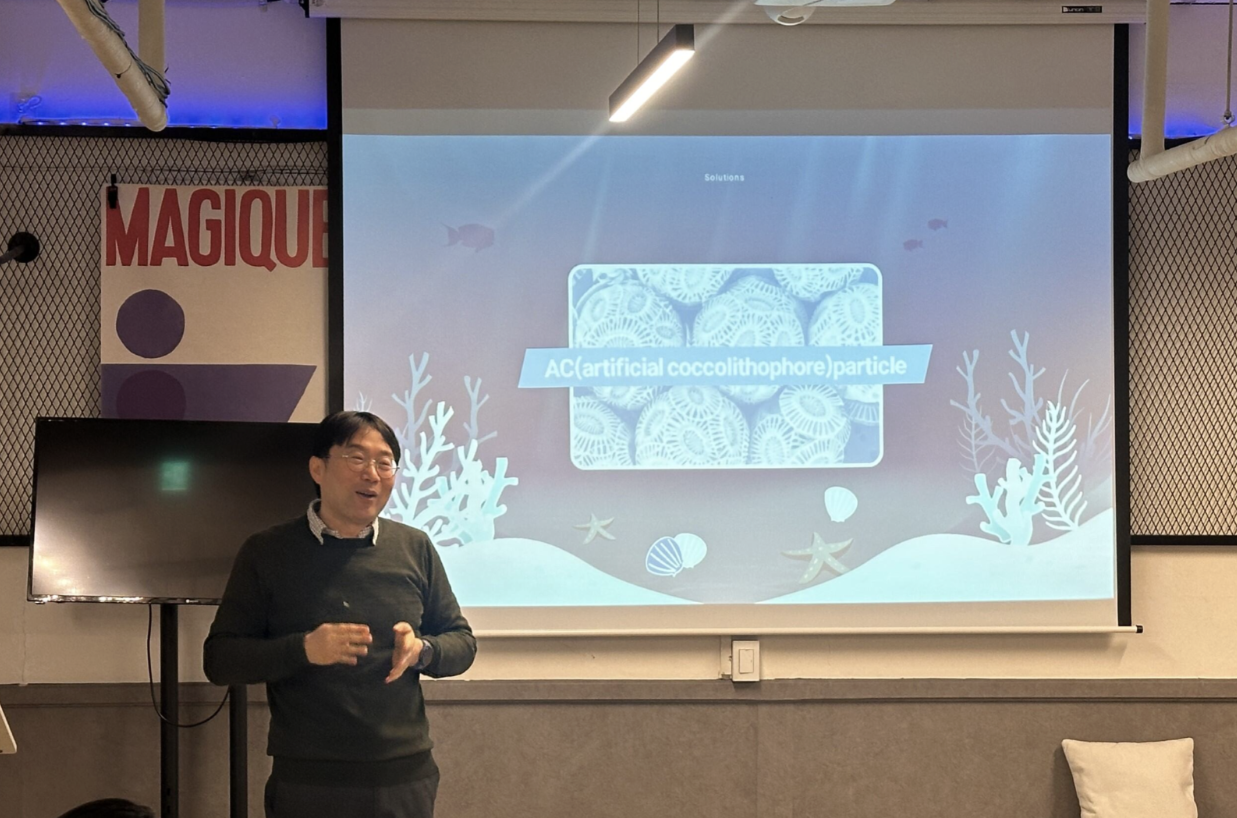
The technology at the heart of BlueCaBorn's approach is an artificial particle modelled on coccolithophores — microscopic marine plankton that naturally absorb dissolved CO₂ and convert it into hard calcium carbonate shells, similar to how oysters and clams form their shells. While shellfish need about two years to lock away significant carbon this way, Prof. Hwang's team discovered a particle capable of mineralising up to 30 percent of its own mass into calcium carbonate in a single day. Combined with Korea's dramatic tidal cycles, where tides in places like the Yellow Sea flow in and out twice every 24 hours, the system can operate without relying on outside power: seawater moves in, CO₂ is captured as a solid mineral, then the treated water flows back out. The resulting calcium carbonate is solid, visible, and measurable, which makes it straightforward to issue verified carbon credits, a kind of certificate that represents one tonne of carbon dioxide removed or avoided.
To avoid introducing microplastic-like particles into open water, the company plans to deploy the technology inside the intake pools already used by coastal industrial plants to filter seawater before use. A proof-of-concept site at the Gochang Marine Technology Research Institute is currently sequestering about 2 kilograms of CO₂ per day, with Lake Sihwa, home to the world's largest tidal power station and holding roughly 100 million tons of water, identified as the next target for scale-up.
The commercial challenge, as Prof. Hwang acknowledged openly, is timing. Carbon removal credits currently sell for around $1,000 per tonne, a price most industrial buyers will not pay when cheaper offset options remain available. The current phase of climate policy is focused on reducing emissions, not removing historical ones. But Prof. Hwang believes a turning point is approaching. As he explained during the lecture, “Right now the world is still in the stage of reducing emissions. But once we reach the limit of what can be reduced, we will have no choice but to remove carbon directly.” BlueCarbon is designed to be ready when that moment arrives.
Overall, the session offered interns a clear-eyed view of where ocean-based carbon capture currently stands, technically promising but commercially early-stage. By connecting Korea's industrial history to the challenge of climate change, Prof. Hwang gave a concrete framework for understanding how geography, engineering, and policy intersect in the emerging carbon market. The lecture was a valuable reminder that meaningful climate solutions do not always come from new technology alone, but from applying existing knowledge in smarter ways.