
By: Jooyeon Han, KGGTF 2026 Youth Intern
On February 12th, the World Bank Group KGGTF Youth Internship Program visited the Seoul Metropolitan Government to gain first-hand insights into Seoul’s climate governance and international development cooperation. Through a series of lectures and a site visit to the Seoul Transport Operation and Informative Service (TOPIS) office, the session offered a comprehensive look at how a city government translates climate ambition and urban innovation into practical systems that shape both local resilience and global knowledge sharing.
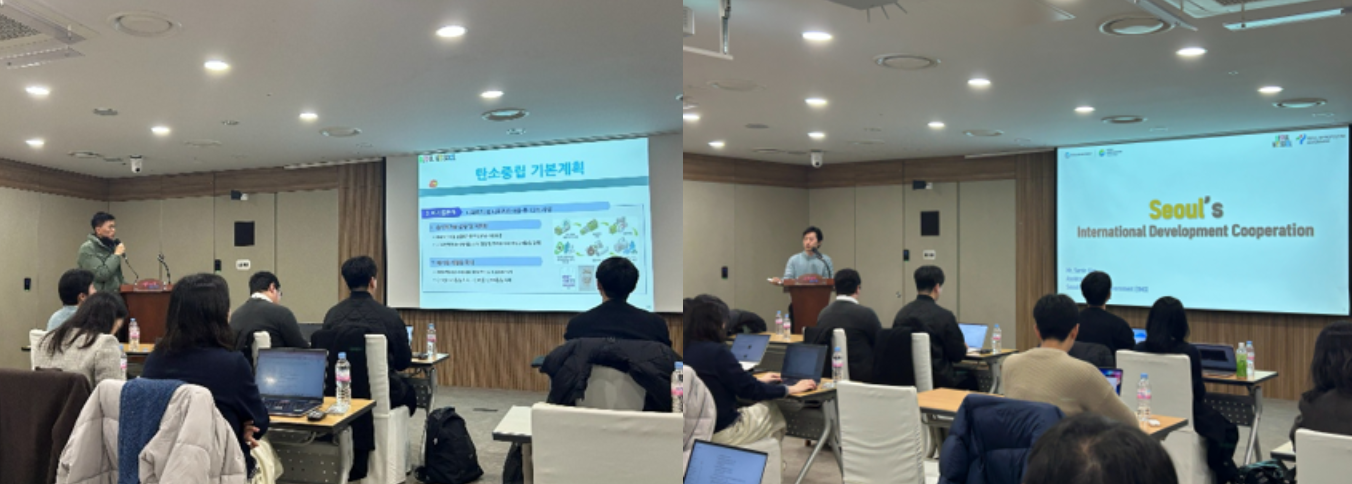
Kim Sung Kwan, Head of the Climate Change Strategy Team, presented Seoul’s integrated approach to carbon neutrality and climate adaptation. Emphasizing that buildings account for nearly 68% of the city’s greenhouse gas emissions, he outlined sectoral measures including public building green remodeling, strengthened Zero Energy Building standards, expanded eco-friendly vehicles, food waste reduction targets, and renewable energy deployment such as solar and geothermal systems. Seoul also has committed to reducing emissions 50% by 2033 compared to 2005 levels under the goal of “2050 Carbon-Neutral Green Seoul.” Beyond mitigation, the city is strengthening flood control infrastructure, upgrading stormwater systems, protecting vulnerable populations from heatwaves, and institutionalizing climate budgeting to assess and disclose the emissions impact of public expenditures – reflecting a shift toward system-wide resilience and accountable climate governance.
Kim Semin, Assistant Director at the International Cooperation Division, then highlighted how Seoul extends its urban policy experience to developing cities. Reflecting on the city’s rapid evolution, he noted that “urban policy and development experiences of Seoul are in high demand from developing countries.” Since 2006, the city has implemented 127 cooperation projects across approximately 50 countries and 85 cities, with transportation accounting for over half of sectoral initiatives. Seoul primarily focuses on development consulting while strategically mobilizing partnerships with central ministries, multilateral development banks, and private actors, including strong collaboration with World Bank and KGGTF to connect advisory work to larger infrastructure investments. The Seoul ODA Challenge, launched in 2024 as the city’s first internally funded ODA program, supports demand-driven advisory, pilot projects, and pre-feasibility studies in cities such as Phnom Penh and Colombo, with the broader aim of leveraging partnerships to scale impact and strengthen citizen-centered urban solutions.
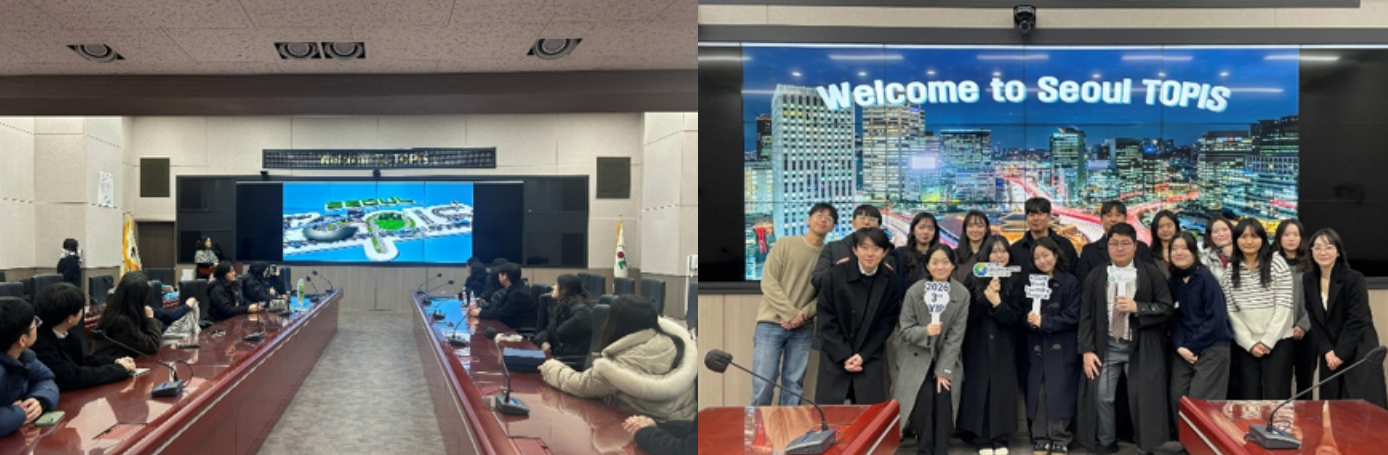
The visit concluded at TOPIS, Seoul’s integrated traffic management and information center, established in 2004 following major public transport reforms. TOPIS integrated GPS data, CCTV feeds, automated enforcement systems, and real-time bus management to optimize traffic flow and provide transparent public information. Systems such as C-ITS and V2X communication enable real-time hazard warnings and support autonomous vehicle testbeds, while green transport zone management has significantly reduced high-emission vehicle traffic in designated areas. As introduced during the session, “Seoul TOPIS is the brand of Seoul’s intelligent transport system and the integrated traffic information center,” reflecting its role as both an operational command center and a model frequently shared with partner cities abroad.
Together, the visit underscored how Seoul operates as both a policy implementer and a knowledge partner. By aligning climate ambition, digital infrastructure, and international cooperation, the city demonstrates how local governance can contribute meaningful to global efforts toward resilient, sustainable, and inclusive urban development.