
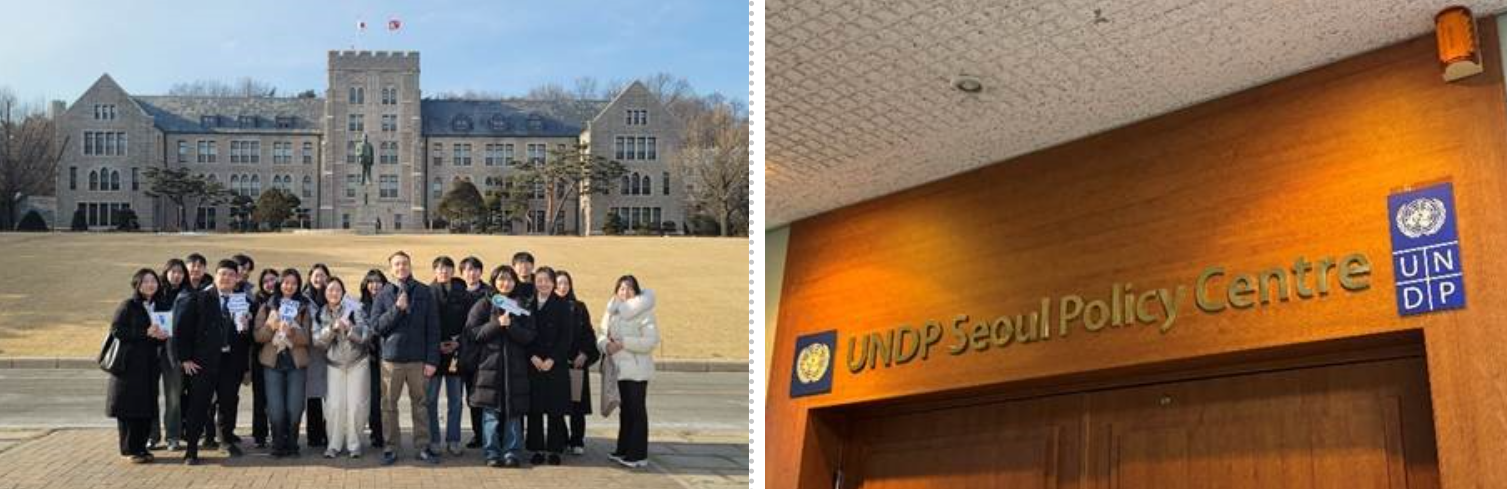
By: Woojeong Yang, KGGTF 2026 Youth Intern
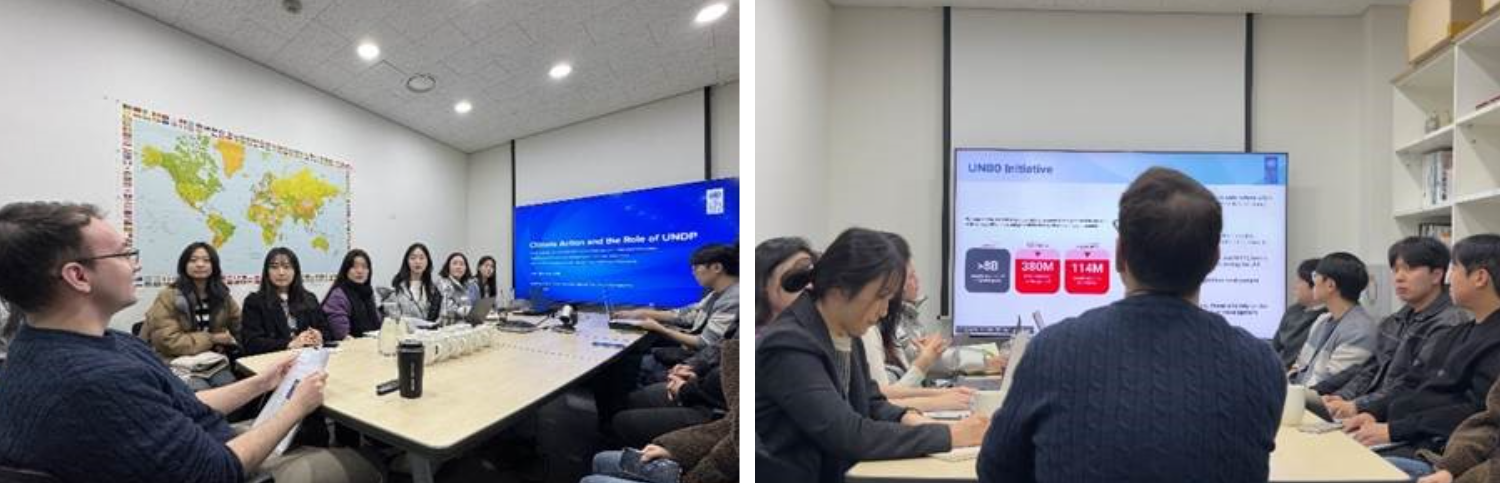
On 30 January 2026, participants in the KGGTF Youth Internship Program visited the UNDP Seoul Policy Centre for a working session on how the UN system operates and how UNDP turns global commitments into practical results. UNDP representatives briefly situated UNDP within the wider UN architecture, then focused on a core implementation question: how international agendas translate into measurable progress in specific national contexts.
Measuring progress and setting priorities
UNDP emphasized that measurement frameworks shape incentives and accountability. The session explained why development cannot be captured by income alone and highlighted the Human Development Index, which combines income, education, and life expectancy. UNDP representatives also introduced complementary indicators that reflect today’s constraints, including measures that account for inequality and planetary pressures such as carbon emissions and material footprint. For interns working across climate, finance, and governance topics, the takeaway was straightforward: what is measured influences what is prioritized, how tradeoffs are managed, and how success is communicated.
From global commitments to national delivery
Climate action was discussed through UNDP’s Climate Promise. UNDP described Climate Promise as a flagship support mechanism that helps countries prepare and strengthen Nationally Determined Contributions under the Paris Agreement, with an emphasis on capacity building and implementation readiness. The session noted that since 2019 UNDP has worked with 127 countries through this initiative, reflecting strong demand for support that moves from targets on paper to action in the field.
UNDP also stressed that climate outcomes are inseparable from nature. Through the Nature Pledge, the Centre highlighted links between biodiversity, ecosystems, and resilience, underscoring that lasting climate progress depends on protecting and restoring natural systems. Nature-based solutions were presented as approaches that can deliver multiple benefits, including risk reduction and livelihood support, when they are designed around local communities and governance realities.
Conditions for transition and accountability in practice
Energy transition and circular economy were approached as delivery challenges rather than slogans. UNDP noted that many near term gains can come from solutions that are already available and scalable, particularly solar and wind, while enabling conditions such as grid integration and digital tools are essential for managing variable renewables. Circular economy was presented as a practical response to unsustainable production and consumption patterns, helping reduce waste and lessen negative externalities embedded in modern lifestyles.
A highlight of the session was the framing of just transition. UNDP cautioned against treating climate change as a purely technical issue, stating: “You cannot just take it as a CO2 emissions or greenhouse gas problem. It is actually a human problem, and it needs human solutions.” The quote anchored a broader discussion about fairness across and within countries, and the need to anticipate distributional impacts so that workers and communities are supported through change, not left behind.
The session concluded with the role of the UNDP Seoul Policy Centre as a partnership platform that translates Korean experience into policy knowledge and targeted support for partner countries. In Q and A, interns asked how results are sustained after projects close and how accountability is maintained. UNDP noted that even when projects are modest in budget, they are designed to be outcome focused and supported by structured monitoring, evaluation, reporting, and audit processes. The discussion reinforced that even small projects can generate outsized impact when they are designed for learning, partnership, and scale from the start.