

By: Sungbin Na and Juwon Keum, KGGTF 2026 Youth Interns
Career Pathways from the United Nations to Multilateral Development Finance
Ms. Heejae Lee, Environment and Social Analyst at the Asian Infrastructure Investment Bank (AIIB), reflected on her professional journey across the United Nations system, the United Nations Development Programme (UNDP), the World Bank Korea Green Growth Trust Fund (KGGTF), and multilateral development banks. Drawing on these experiences, she highlighted how transitioning across different institutional settings requires adapting to varying operational models, from policy-oriented multilateral organizations to project-driven development finance institutions. Her remarks focused on the practical skills, technical competencies, and strategic career decisions that shape professional pathways in international development.
Ms. Lee began by reflecting on her career journey, highlighting the importance of understanding the mindset shift required when transitioning from the United Nations system to multilateral development banks (MDBs). While UN institutions often focus on normative frameworks, governance processes, and consensus-building, MDBs emphasize operational delivery, investment decision-making, and measurable project outcomes. She explained that MDB professionals must be able to assess whether proposed initiatives are investable while ensuring that projects meet both financial sustainability and environmental and social responsibility standards.
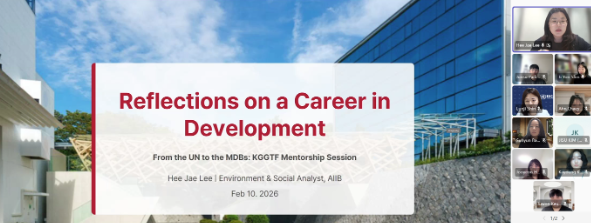
Providing an overview of AIIB’s development approach, Ms. Lee introduced the institution’s strategic framework, Infrastructure for Tomorrow (i4t), which focuses on building infrastructure that is environmentally sustainable, socially inclusive, and economically viable. Through innovative financing mechanisms and partnerships with both public and private actors, AIIB mobilizes capital for infrastructure investments that support long-term economic growth, regional connectivity, and climate-resilient development. She emphasized that infrastructure investments today must generate not only financial returns but also broader environmental and social benefits.
Ms. Lee also discussed her role as an Environment and Social (E&S) Analyst, explaining that E&S specialists support project teams throughout the entire project cycle: from early screening and risk categorization to mitigation planning, compliance monitoring, stakeholder engagement, and project evaluation. This work ensures that infrastructure investments comply with international safeguards standards while effectively managing environmental and social risks associated with large-scale development projects.
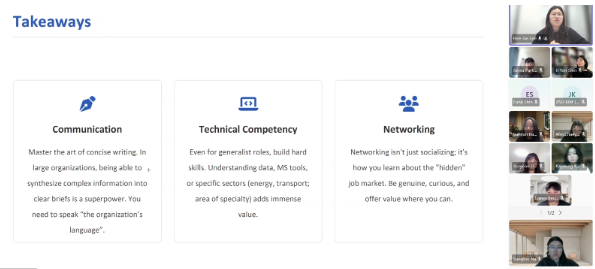
Turning to career development, Ms. Lee encouraged interns to build strong technical competencies, even for generalist career paths. Developing analytical and technical skills, understanding institutional mechanisms such as the MDB project cycle, and cultivating specialized expertise can significantly strengthen early-career entry into development finance institutions. She also highlighted the importance of concise communication, professional networking, and positioning oneself as a reliable problem solver capable of contributing practical solutions within institutional environments.
Concluding the session, Ms. Lee encouraged participants to approach career development strategically by combining specialization with adaptability. She emphasized that successful careers in international development are built not only on commitment to global issues but also on the technical knowledge, operational understanding, and professional relationships that enable development initiatives to translate into tangible and sustainable outcomes.
Eunji Shin, JPO at UN ESCAP: Strategic Coordination and Institutional Perspective
Eunji Shin began her career as a Young Professional at KOICA before joining KGGTF as an intern and later working as a consultant in the World Bank’s Environment, Natural Resources, and Blue Economy Global Practice. She currently serves as a Junior Professional Officer at the Executive Secretary’s Office of UN ESCAP. Her lecture focused on the structural distinctions between multilateral development banks and the UN system, as well as the evolving nature of strategic and coordination roles within international organizations.
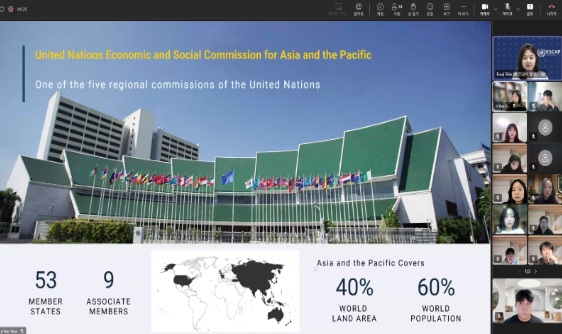
UN ESCAP, one of the five regional commissions of the United Nations, serves 53 member states and 9 associate members across the Asia-Pacific region. Unlike multilateral development banks, which concentrate on project financing and implementation, ESCAP functions primarily as a platform for intergovernmental dialogue and regional policy coordination.
Working within the Executive Secretary’s Office, Shin contributes to the strategic alignment of organizational priorities. Her responsibilities include reviewing activities related to vulnerable country groups such as Least Developed Countries, Small Island Developing States, and Landlocked Developing Countries, identifying overlaps and gaps across divisions, and supporting regional cooperation frameworks including ASEAN–UN action planning. Her role reflects a shift from project-level engagement toward institution-wide strategy and policy coordination.
Shin highlighted the importance of building niche expertise in a competitive development landscape. During the COVID-19 period, she pursued an additional master’s degree in plastic waste management at the Asian Institute of Technology, using the moment of uncertainty to deepen her technical specialization. She emphasized that cultivating expertise at the intersection of sectoral focus and regional knowledge can strengthen professional positioning within global institutions.
She also addressed networking and recruitment strategies, noting that preparation is essential. Researching colleagues’ portfolios before engagement and structuring responses around competency-based frameworks are practical approaches to career advancement. In line with the concept of T-shaped professionals, she stressed the need to combine deep technical expertise with broader skills in writing, policy analysis, and collaboration.
Through their reflections, both speakers offered a comparative perspective on career development across multilateral development banks and UN systems. Their experiences illustrated that international development careers are rarely linear and require deliberate specialization, adaptability, and the ability to navigate institutional complexity.