
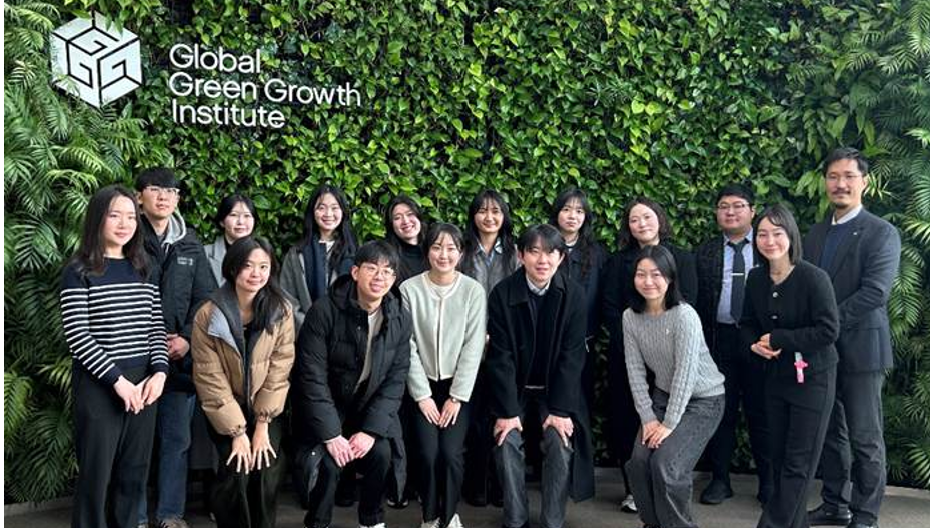
By: Chaeyeon Ahn, KGGTF 2026 Youth Intern
On February 5th, the Korea Green Growth Trust Fund (KGGTF) Youth Internship Program (YIP) interns visited the Seoul Headquarters of the Global Green Growth Institute (GGGI). Established in 2012 as an international organization, GGGI brings together 54 member states with the shared vision of promoting “strong, inclusive, innovative, and sustainable growth.”
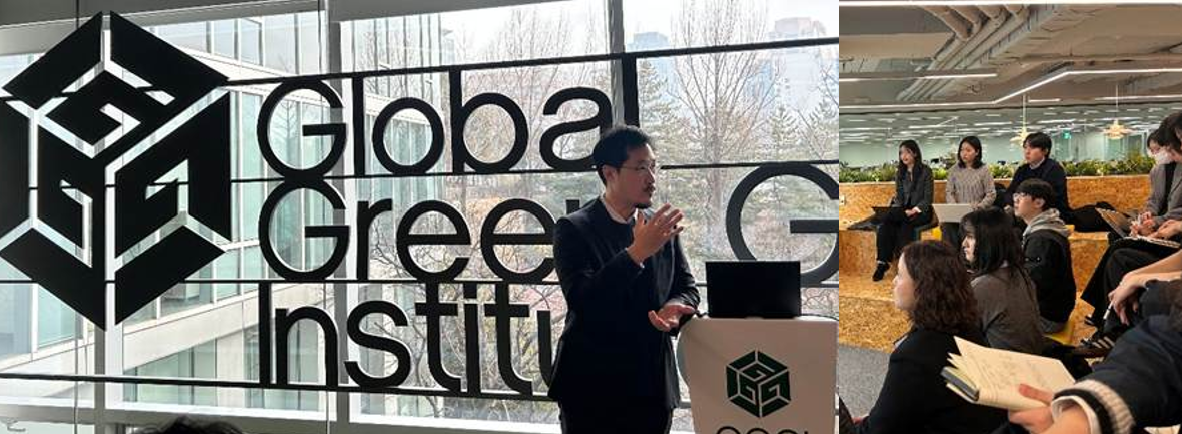
The visit began with welcoming remarks from Mr. Dukwoo Jun, Head of the Green Trust Fund Unit, who shared his professional background and reflections on what motivated him to pursue a career in international development cooperation. He introduced GGGI’s core role in supporting developing countries by translating policy objectives into actionable solutions. Drawing on collaboration with governments and Multilateral Development Banks (MDBs), including the World Bank, he explained how GGGI assists countries in designing laws and policies, establishing public institutions, issuing green bonds, and developing national green growth roadmaps. Mr. Jun emphasized that development challenges rarely have a “silver bullet,” and that sustainable solutions require a comprehensive understanding of local conditions and meticulous planning across financing, procurement, and logistical capacity, while also accounting for international political and diplomatic dynamics. In response to the interns’ questions, he highlighted that Green Artificial Intelligence (AI) as the emerging thematic focus for GGGI, including both the use of AI to accelerate green growth and efforts to reduce the environmental footprint of AI technology. He also stressed that GGGI consciously prioritized economic value and measurable impact, positioning the organization not merely as an environmental protection agency, but as a strategic partner for green growth.
The session continued with a presentation by Mr. Jihyun Kim, Fund and Investment Officer, who provided an overview of GGGI and the Korean Green New Deal Trust Fund (KGNDTF). Supported by Korea’s Ministry of Economy and Finance (MoEF) since 2022, it has contributed to reducing approximately 50 million tons of greenhouse gas emissions across Asia, Africa, and Latin America and the Caribbean by 2024. Mr. Kim outlined GGGI’s project development process, underlining the importance of the initial stage of “problem awareness,” explaining that understanding why a problem exists and why current systems functions as they do is essential for designing viable and effective projects. Illustrating case studies on e-mobility adoption in Mexico and Rwanda and one on promoting biochar as an alternative to open burning, he further iterated the process, which is continued by challenge and solution linkage and rethinking innovation. Concluding his presentation, he emphasized green growth as “the climate crisis caused by humanity must be solved by simultaneously pursuing economic growth and environmental policies,” and that “green growth is the way to benefit humanity while doing justice to the Earth.”
Following the insightful sessions on the work of the organization, Mr. Benjamin Devise, Carbon Pricing Associate, and members of GGGI’s Human Resources team, Mr. Juan Miguel Osuna Alarcón and Ms. Tumurjargal Bukhchuluun, led a career talk introducing career opportunities and recruitment processes within the organization.
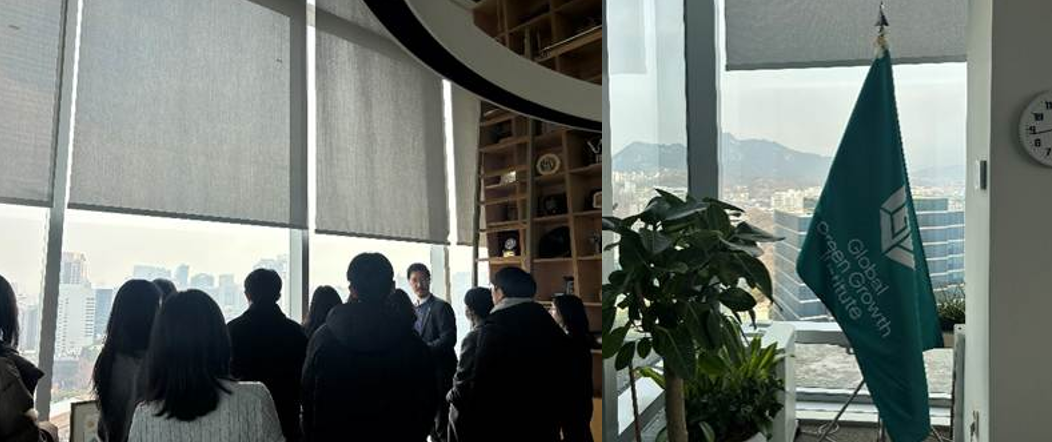
The visit concluded with a guided tour of the GGGI headquarters, including the office of the GGGI President and Chair, Mr. Ban Ki-moon. Reflecting on Korea’s development experience, Mr. Jun noted that while Korea’s path is not universally replicable, its value lies in the lived experience of remarkable transformation, which left insights that GGGI can adapt and tailor to the different contexts of its member states. Concludingly, he encouraged the interns to remain “attentive to shifting global dynamics” and to “train ourselves with skills that are will not be replaced by AI, most significantly decision making based on human judgement and coordination.”