
By: Hangyeol Kim, KGGTF 2026 Youth Intern
Korea’s development journey, built through decades of investment and policy reform, is now part of the World Bank Group’s global knowledge base. The challenge today is how those lessons can support countries pursuing sustainable and climate-aligned growth.
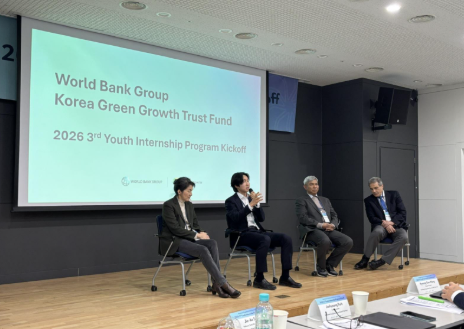
On January 9th, 2026, the World Bank Group KGGTF Youth Internship Program held its kickoff meeting, bringing together the experts from World Bank Group Korea Office and KGGTF to share their roles and insights on sustainable development. Milen F. Dyoulgerov Vollen, Senior Environmental Specialist; Myoe Myint, Senior Energy Specialist; Jie-ae Sohn, Senior Consultant at the WBG Korea Office; and Hoonhee Park, Underwriter at the Multilateral Investment Guarantee Agency (MIGA) Korea Office delivered insight presentations followed by a panel Q&A for the incoming interns. This article highlights their discussion on what Korea’s development experience represents and what it means to share that experience in today’s context.
Jie-ae Sohn described Korea as “the poster child of the World Bank.” She explained that Korea’s transformation from one of the poorest countries after the Korean War into an industrialized economy was enabled by long-term investments in infrastructure, energy, finance, institutions, and human capital, many of which were supported by the World Bank Group. Today, Korea is no longer only a financial donor but also a knowledge partner, sharing its development strategies and policy experience through platforms such as the Korea–World Bank Global Digital Knowledge Center.
At the same time, while Korea’s development achieved remarkable economic success, it was not without setbacks. Some initiatives failed, and others, though economically successful, generated negative social and environmental impacts. Sharing Korea’s development experience, therefore, goes beyond highlighting achievements alone. It also means sharing mistakes, areas for improvement, and lessons that serve as cautionary examples, providing a rich set of case studies for others to analyze and learn from. As she noted, “Korea’s path has shown that there are different avenues that you can grow, and you can fix what you have broken.” She cited the Cheonggyecheon restoration in Seoul as an example of how damage from rapid industrialization can later be reversed, transforming a polluted, covered stream into a public and ecological space.
Milen F. Dyoulgerov Vollen added that Korea’s development experience should be understood as an ongoing process rather than a finished chapter. He described Korea’s model as “learning by doing.” Korea continues to test and refine policies while mobilizing both public and private resources for green growth. While green growth has been widely discussed since the 2010s, he noted that Korea is among the few countries to have pursued implementation through government plans and pilot initiatives across sectors. In this sense, green growth is not one large transformation but the accumulation of many smaller initiatives, each generating practical lessons through both success and failure.
Together, the speakers stressed that development experience is dynamic. Korea continues to evolve as it undertakes new projects and partnerships at home and abroad. Korea’s experience, therefore, offers not a single model to replicate, but a set of lessons that can inform how countries design, finance, and implement green growth strategies in their own contexts.