
By: Jooyeon Han, KGGTF 2026 Youth Intern
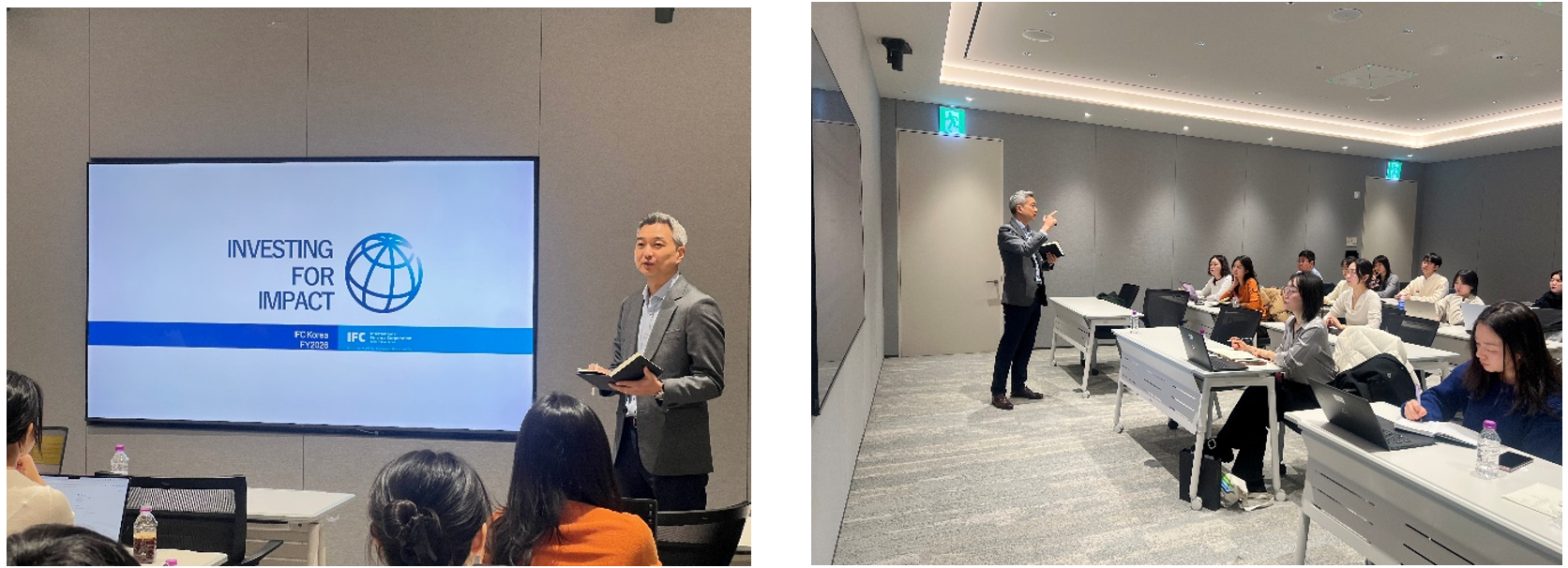
On January 15th, the World Bank Group KGGTF Youth Internship Program hosted a special lecture by Jae Hyung Kwon, Representative of the International Finance Corporation (IFC) Korea Office. Drawing on his professional experience in international finance and project financing, Kwon offered a practical and insightful view of how IFC operates at the intersection of development impact and commercial viability.
Jae Hyung began by situating IFC within the broader World Bank Group (WBG) structure, emphasizing its distinct role to support private-sector investment in developing countries, addressing market failures where commercial finance alone is insufficient. At the core of IFC’s approach is its 2030 Strategy, which aligns with the WBG’s overarching mission to create more and better jobs. The employment creation does not occur in isolation, but is closely tied to strategic sectors such as infrastructure, health care, agriculture, high-value manufacturing, and tourism. To maximize development impact, IFC is increasingly scaling up equity investments, enabling the institutions to take an ownership stake and support long-term growth.
A central theme of the lecture was mobilization – IFC’s effort to crow in private capital at scale. IFC plays a catalytic role, using its own balance sheet, credibility, and structuring expertise to attract co-financing from private investors. IFC employs a diverse suite of investment products combined with upstream and advisory services to support governments and companies in project preparation, regulatory reform, and investment structuring to make projects bankable and sustainable. The illustrated cases including LG Innotek’s Sustainability-Linked Loan in Vietnam and the Upper Trishuli 1 Hydropower Project in Nepal demonstrated IFC’ role as long-term development partner and financier.
Reflecting on IFC’s approach, Kwon emphasized transparency and accountability, noting that IFC projects are subject to independent evaluation and rigorous performance standards that have become global benchmarks. He also highlighted that “to mobilize private capital development, you must first understand the incentives of the private sector.” Over time, he noted, success in development finance not only on analytical ability, but also on becoming a “great communicator others want to have a conversation with,” emphasizing the fullness and enjoyment that comes from communication across global contexts.
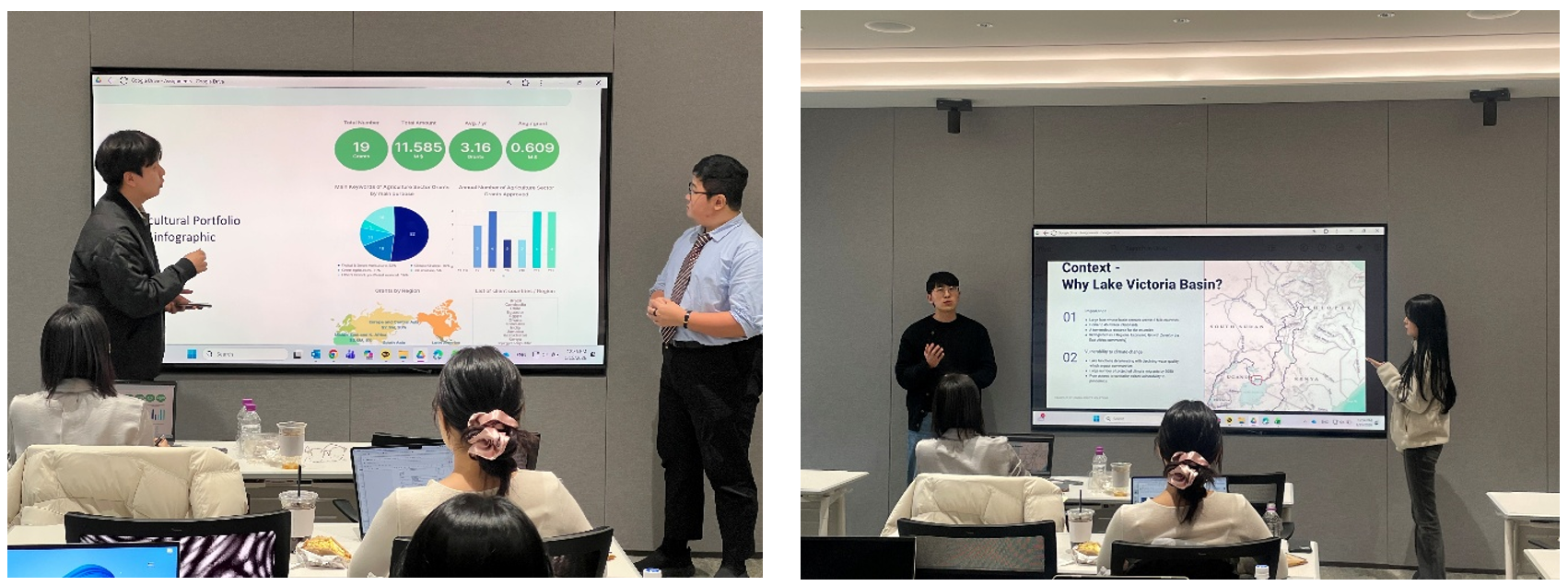
Following the lecture, interns reconvened for a session to share overviews of their assigned sectors across the seven priority areas of KGGTF. Interns presented progress on cross-checking and editing the KGGTF sectoral book, exchanging insights from grant cases and discussing how KGGTF-supported projects contribute to climate resilience and inclusive growth.
Together, the lecture reinforced a broader understanding of development finance as an interconnected system. Sustainable development is not driven by a single instrument, but by coordinated efforts that align finance, policy, and long-term impact across contexts.