
Read full report from Knowledge Exchange (click here)
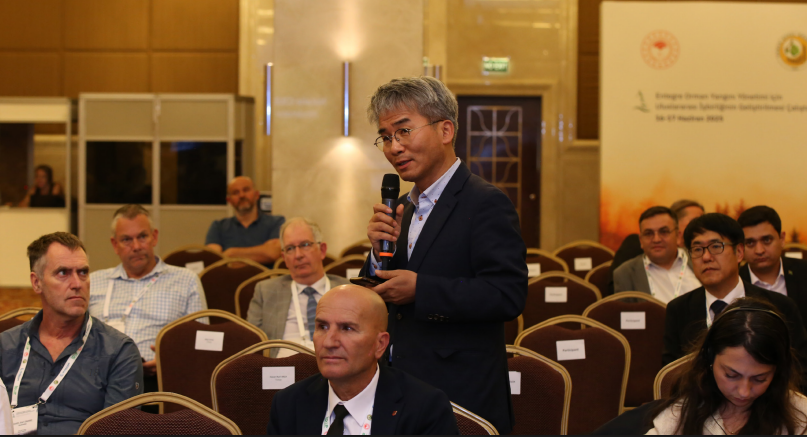
As forest fires grow in frequency and intensity across the Mediterranean and beyond, countries are recognizing the urgent need for coordinated, data-driven fire management. The Türkiye Regional Fire Dialogue, a knowledge exchange held over three days in June 2025, brought together Environment, forestry and disaster risk management teams from across the Europe and Central Asia (ECA) region for an in-depth knowledge exchange focused on integrated forest fire management (IFM), innovation, and cross-border collaboration.
The event drew approximately 150 participants from around the world—including representatives from Albania, Australia, Austria, Azerbaijan, Bosnia, France, Georgia, Kazakhstan, Korea, Montenegro, Portugal, Tajikistan, Turkmenistan, Tashkent (Uzbekistan), and the United States.
Funded by the Korea Green Growth Trust Fund (KGGTF), the knowledge exchange was hosted by Türkiye’s General Directorate of Forestry (OGM) in partnership with the World Bank. It provided a platform for sharing lessons, showcasing country innovations, and building momentum for a regional approach to forest fire resilience.
World Bank Leadership on the Frontlines of Climate and Risk Management
Senior World Bank leaders helped set the tone for the dialogue, underscoring the institution’s strong commitment to supporting regional resilience and climate-smart forest management. Valerie Hickey, Global Director for Climate Change, emphasized the need to rethink how we prepare for and respond to fires—not just as disasters, but as symptoms of broader development challenges. Humberto Lopez, Country Director for Türkiye, highlighted the importance of World Bank-Türkiye cooperation and noted how Türkiye’s experiences offer powerful lessons for the region. Sameh Wahba, Regional Practice Director for the Planet, ECA, placed forest fires in the context of wider climate and land management challenges facing ECA countries, while Sanjay Srivastava, Regional Manager for Disaster Risk Management, ECA, moderated practical sessions that connected global knowledge to national strategies. Their presence helped bridge global policy frameworks with local realities—reinforcing the World Bank’s role as a trusted partner in turning data, dialogue, and innovation into action.
Türkiye’s Challenge and Response
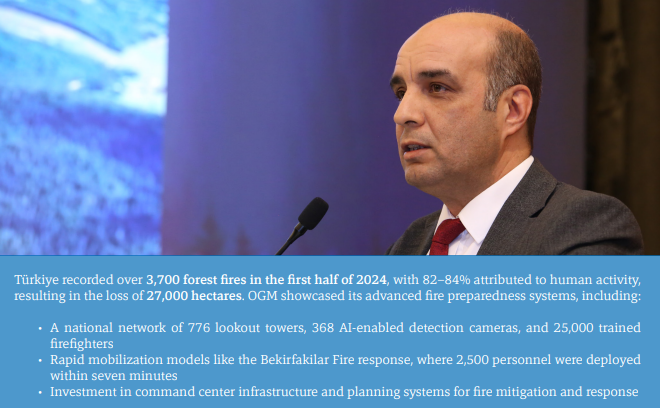
Türkiye experienced more than 3,700 forest fires in the first half of 2024 alone—approximately 82 to 84 percent of which were caused by human activity, according to data from the General Directorate of Forestry and public statements by Forestry Minister İbrahim Yumaklı. These fires destroyed roughly 27,000 hectares of land, underscoring the urgent need for both preventative measures and rapid response (Global Panorama, International Fire and Safety Journal).
Türkiye manages 23.4 million hectares of forest, nearly two-thirds of which are classified as high fire risk. Under OGM’s leadership, the country has:
-
Built a robust network of 776 fire lookout towers, 368 detection cameras, and 25,000 firefighters
-
Responded within seven minutes to major incidents like the 2024 Bekirfakilar fire, which mobilized nearly 2,500 personnel
-
Continues to build the capacity of Incident Command System
-
Structuring its strategic planning to enhance the prevention and mitigation of fire risk
The True Cost of Forest Fires
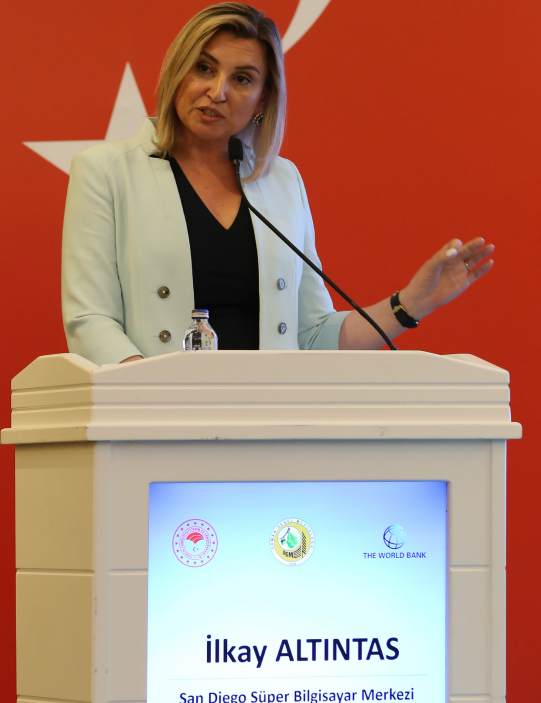
Meakers emphasized that the cost of inaction is staggering:
-
Forest fires cause more than $50 billion in direct economic damage annually
-
Health impacts from forest ire smoke—such as respiratory illness and premature death—exceed $200 billion per year
-
Forest fires now contribute up to 20% of global greenhouse gas emissions
According to Nick Loris of C3 Solutions, prevention isn’t just smart policy—it’s sound economics: for every euro invested in forest ire prevention, four to seven euros are saved in avoided losses.
Smarter Data, Better Decisions
Participants explored how AI, satellite imagery, and drone technologies are transforming fire management:
-
Türkiye and Korea have deployed AI-assisted detection networks and UAVs that feed real-time data to mobile units
-
International partners such as the FAO are using remote sensing to inform fire risk reduction and post-fire recovery
-
Data gaps remain in areas like smoke dispersion modeling and long-term health monitoring, especially in low-capacity settings
Global Lessons, Regional Action
Speakers from Australia, Portugal, Korea, France and the US reinforced that forest ire risk is not just a technical issue—it’s a governance and social one. Key takeaways included:
-
Portugal: Addressing land abandonment and fragmented forest ownership is essential, and demonstrated the business case for investing in prevention yields results for forest fire mitigation
-
Australia: Shared fire hazard indexes that inform building codes and land-use planning
-
Korea: Showcased smart command centers and coordinated evacuation systems
-
United States: Highlighted the Firewise program, which helps communities reduce fire risks around homes
-
France: Shared the country’s focus on pre fire monitoring to reduce the cost of response.
Investing in People and Preparedness
Türkiye’s multi-platform alert system and disinformation monitoring center underscored the importance of public trust and timely communication. Programs like Safe Villages (Portugal) and Firewise (US) showed how community-level engagement is critical for long-term resilience.
A Call for Regional Collaboration
Final sessions emphasized that no country could face this threat alone. FAO’s Global Fire Hub and the Asian Forest Cooperation Organization (AFoCO) presented frameworks for shared learning and capacity building across borders. Private sector innovators demonstrated how satellite constellations, remote-operated equipment, and AI can support and scale national efforts.
As one participant noted: “Wildfire resilience begins not in the heat of the emergency, but in the quiet months of planning, investment, and solidarity.”
The Türkiye Regional Forest Fire Dialogue highlighted that while forest fires may be inevitable, the solutions—anchored in prevention, innovation, and regional partnership—are well within reach.
Read the Op-Ed: Forest Fires Are Spreading—And So Must Global Solutions
Explore Presentations and Event Materials: Enhancing International Cooperation for Integrated Forest Fire Management