
By: Injun Song, KGGTF 2025 Youth Intern
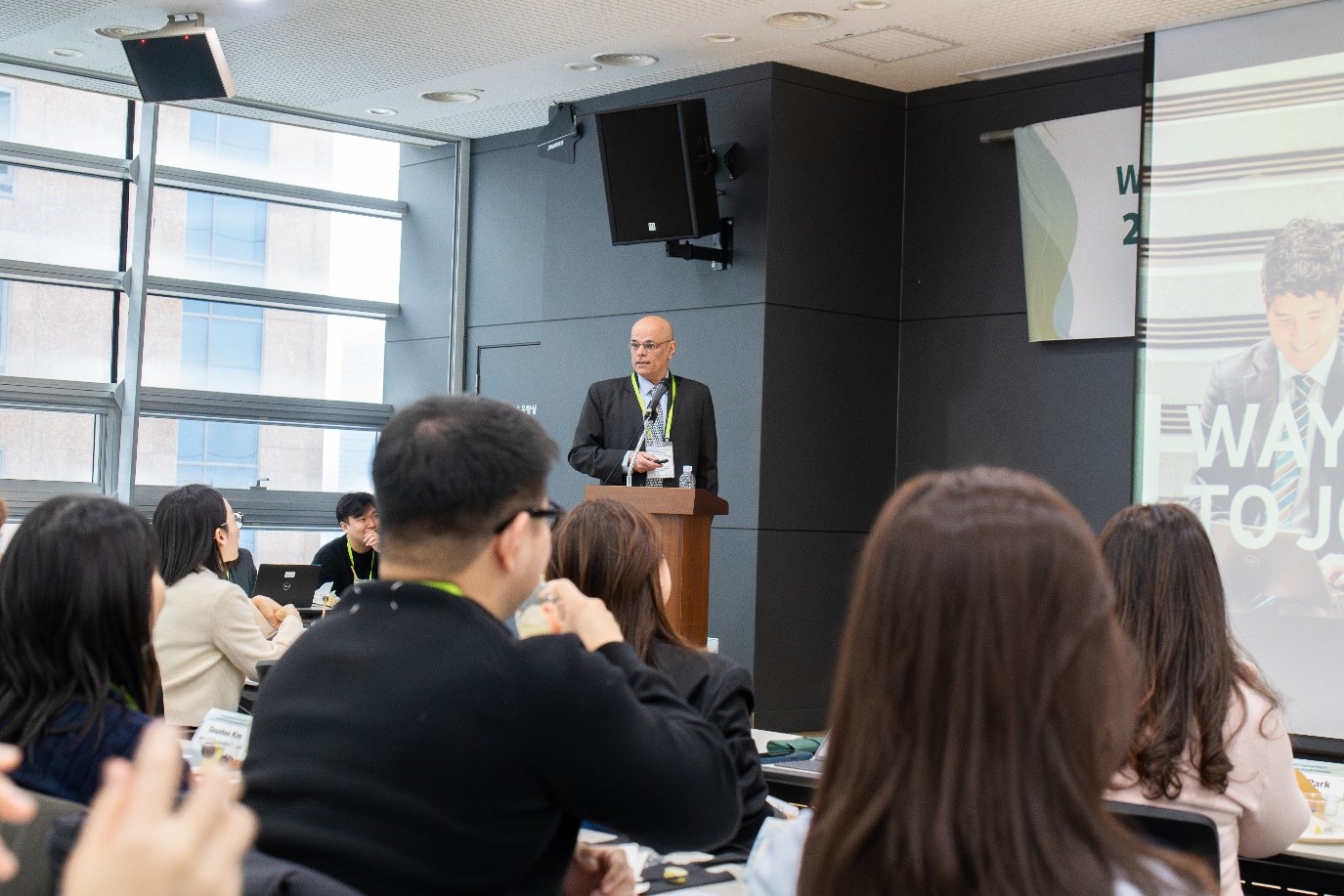
On Friday, December 20, 2024, Dr. Sameer Akbar, Senior Environmental Specialist at the World Bank Group (WBG) Korea Office, officially introduced the second batch of Korean Green Growth Trust Fund (KGGTF) interns to the World Bank Group. During his lecture, “Introduction to the World Bank, WBG Korea Office,” Dr. Akbar welcomed 21 interns, offering an insightful overview of the World Bank’s mission to end extreme poverty and boost shared prosperity on a livable planet.
Dr. Akbar began the session by sharing highlights from his 25-year journey in the World Bank. His career engagement with the World Bank began in India, his home country, and he has since spanned multiple countries and continents. His devotion to the organization arises from his academic background in sustainable development, environment, and climate change. His academic pursuits, culminating in a Ph.D. in environmental policy, offered him the specialized expertise required to deal with complex, cross-cutting issues. Dr. Akbar shared a personal anecdote in Vienna, Austria, where his work included establishing an internship program in collaboration with nearby academic institutions—much like the KGGTF Youth Internship Program. He emphasized the need to empower the youth to become leaders in green growth and sustainable development.
Following his personal reflections, Dr. Akbar offered a comprehensive overview of the World Bank’s history and structure. The organization traces its roots back to 1944, when the United Nations Monetary and Financial Conference held in Bretton Woods led to the founding of the World Bank. Initially tasked with rebuilding economies devastated by World War II, the Bank later expanded its scope to support economic development worldwide. Its present-day mission is to end extreme poverty and boost shared prosperity on a livable planet.
Dr. Akbar explained that the World Bank Group comprises five institutions, each with a specific focus area. The International Bank for Reconstruction and Development (IBRD) provides loans and advice to middle-income and creditworthy low-income countries to foster economic development. The International Development Association (IDA) serves the world’s poorest countries and provides concessional loans and grants for sustainable, long-term development. The International Finance Corporation (IFC) focuses on the private sector in emerging markets. Meanwhile, the Multilateral Investment Guarantee Agency (MIGA) provides political risk insurance to encourage foreign direct investment in developing countries. Lastly, the International Centre for Settlement of Investment Disputes (ICSID) facilitates dispute resolution and arbitration between international investors and host governments. Together, these institutions collaboratively provide governments and the private sector with the resources and assistance to address development challenges.